Showing posts with label European Convention. Show all posts

Tuesday, 19 May 2015

Ashers Bakery and the "Gay Cake"


Judgment has been delivered in the Northern Ireland case of  Lee v Ashers Baking Company [2015] NICty 2 (Court summary HERE).  The case considered whether it was illegal for Ashers to refuse to bake a cake which carried a logo saying "support gay marriage" along with a picture of Bert and Ernie from Sesame Street, and the logo of the organisation  'Queerspace'.  More background facts available HERE and a picture below of what Mr Lee wanted putting on the cake


Unlike many similar cases which involved Bakeries refusing to make a cake for a Same-Sex Marriage reception this case involved a Bakery being asked to bake a cake which explicitly endorsed the campaign to legalise Same-Sex Marriage in Northern Ireland.  The Company was run by a family who are devout Christians and who believe that Marriage is between a Man and a Woman

The case revolved around 2 separate legal issues namely whether the refusal to make the cake constituted Discrimination on the grounds of Sexual Orientation contrary to the  Equality Act (Sexual Orientation) Regulations (Northern Ireland) 2006 and whether it constituted unlawful discrimination on the grounds of Political Opinion contrary to the  Fair Employment and Treatment (Northern Ireland) Order 1998.

Northern Ireland is unique in the UK for in making discrimination on the grounds of political opinion explicitly unlawful and this arises from the long history of sectarian division in Northern Ireland where religion, nationality and political opinion were so often synonymous with British/Unionist/Protestant identity facing Irish/Republican/Catholic identity.

Surprisingly in this case the Judge held that the refusal of Ashers to bake the cake constituted direct discrimination on the grounds of sexual orientation simply on the basis that the buyer, a Mr Lee, happened to be Gay even though many supporters of Gay Marriage are heterosexual and similarly many Gay people are opposed to Gay Marriage.  As is usual in these cases the Judge paid lip service to the Ashers rights to Religious Freedom under Article 9 and then stated that the law overode those rights

Somewhat less surprisingly the Judge also decided that the refusal constituted discrimination on the grounds of political opinion.  Damages were assessed as a nominal figure of £500.

The case will undoubtedly be appealed but what does emerge from it is the complete intolerance of the "Equality" industry and the way in which Equality Law is being used to destroy individual freedom including the freedom of a Bakery company to decide what products it wants to make.  

We in Britain have just been celebrating the 70th anniversary of our victory in WW2 but frankly what are we celebrating ?, 'Freedom', but not if you run a Bakery it would seem.  

Wednesday, 1 April 2015

Religious Freedom and Education in Quebec - Loyola High School case

The Supreme Court of Canada has supported the Religious Freedom rights of a Catholic School in the Province of Quebec in a case which revolved around s2 of the Canadian Charter of Rights and Fundamental Freedoms  which is the section that protects Religious Freedom in Canada

The case of  Loyola High School v. Quebec (Attorney General), 2015 SCC 12 (CanLII) was the culmination of a 5 year legal battle over the teaching of a compulsory curriculum on Ethics and Religious Culture as opposed to teaching the subject in conformity with the Catholic beliefs which were part of the inherent identity of the School

Since September 2008, as part of the mandatory core curriculum in schools across Quebec, the Minister of Education, Recreation and Sports had required all schools in Quebec to teach a Program on Ethics and Religious Culture (ERC), which teaches about the beliefs and ethics of different world religions from a neutral and objective perspective.

 The stated objectives of the ERC Program are the “recognition of others” and the “pursuit of the common good” seeking to inculcate in students "openness to human rights, diversity and respect for others" (or to put it another way the usual meaningless PC claptrap which has inflitrated speech and political discourse in the English [and French] speaking world).

To fulfil these objectives, the ERC Program has three components: world religions and religious culture, ethics, and dialogue. The three components are intended to support and reinforce one another. The orientation of the Program is strictly secular and cultural and requires teachers to be objective and impartial. Teachers are not to advance the truth of a particular belief system or attempt to influence their students’ beliefs, but to foster awareness of diverse values, beliefs and cultures. 

The course was compulsory in Provincial state schools but under s. 22 of the Regulation  the Minister can grant private independent schools an exemption from the specific requirements of the ERC Program if the School provides an alternative program which is deemed to be “equivalent”. Loyola wrote to the Minister to request an exemption from the Program, proposing an alternative course to be taught from the perspective of Catholic beliefs and ethics. The Minister denied the request based on the fact that Loyola’s whole proposed alternative program was to be taught from a Catholic perspective. It was not, as a result, deemed to be “equivalent” to the ERC Program.

Loyola brought an application for judicial review of the Minister’s decision. Loyola High School c. Courchesne, 2010 QCCS 2631 (CanLII)  where the Superior Court decided that the Minister’s refusal of an exemption infringed Loyola’s right to religious freedom under the Charter, quashed the Minister’s decision, and ordered an exemption. On appeal Québec (Procureur général) c. Loyola High School, 2012 QCCA 2139 (CanLII)  the Quebec Court of Appeal  overuled the Superior Court and concluded that the Minister’s decision was reasonable and did not result in any breach of religious freedom. 

At the Supreme Court hearing Loyola modified its request to teach the whole ERC program from a Catholic perspective, and was prepared to teach about the doctrines and practices of other world religions neutrally but it still wanted to teach about the ethics of other religions from a Catholic perspective. The Minister’s position however remained the same namely that no part of the ERC program could be taught from a Catholic perspective.

The Supreme Court decided that the Minister’s decision requiring that all aspects of Loyola’s proposed program be taught from a neutral perspective, including the teaching of Catholicism, limited freedom of religion more than was necessary and as a result, it did not reflect a proportionate balancing and should be set aside. The appeal was allowed and the matter remitted to the Minister for reconsideration.

The court held para 79 
"it is the Minister’s decision as a whole that must reflect a proportionate and therefore reasonable balancing of the Charter protections and statutory objectives in issue.  It does not, in my respectful view, because it rests on the assumption that a confessional program cannot achieve the objectives of the ERC Program."

A particularly important point of principle relating to the rights of Religious Organisations, including religious schools, was dealt with in paras 90 -91

[90]  The Attorney General of Quebec contends that Loyola enjoys no such constitutional protection because it is not a natural person, but merely a legal person:  religious freedom protects sincerely held beliefs, and a corporation is capable of neither sincerity nor belief.  This raises the question of whether religious organizations are protected by the guarantee of freedom of religion.


[91]  In our view, Loyola may rely on the guarantee of freedom of religion found in s. 2(a) of the Canadian Charter.  The communal character of religion means that protecting the religious freedom of individuals requires protecting the religious freedom of religious organizations, including religious educational bodies such as Loyola.  Canadian and international jurisprudence supports this conclusion.

The Court accepted therefore that Loyola’s teachers were permitted to describe and explain Catholic doctrine and ethical beliefs from the Catholic perspective. They agreed with the principle of the ERC course that Loyola’s teachers must describe and explain the ethical beliefs and doctrines of other religions in an objective and respectful way but accepted that where the context of the classroom discussion requires it, they may identify what Catholic beliefs are, why Catholics follow those beliefs, and the ways in which other ethical or doctrinal propositions do not accord with those beliefs.

An interesting point was raised in para 150 regarding the fact that a completely secular approach was not necessarily a neutral approach
150 By using as her starting point the premise that only a secular approach to teaching the ERC Program can suffice as equivalent, the protection contemplated by the s. 22 exemption provision was rendered illusory.

This mirrored to some extent similar points made by the European ourt of Human Rights in the Lautsi (Italian Crucifix) case in 2011

A preference for secularism over alternative world views—whether religious, philosophical or otherwise—is not a neutral option.

The case may well be too specific to Quebec legislation for it to have a wider influence but since s2 of the Canadian Charter is similar to Article 9 of the European Convention on Human Rights this case could be of value to UK Religious based Schools should they feel that parts of the National Curriculum are contrary to their religious nature and identity.  It may be particularly helpful as providing some guidance and reassurance for religious schools considering the difficult question of how they are to teach about same-sex marriage and same-sex relationships

Thursday, 12 March 2015

Equality and Human Rights Commission Report

The Equality and Human Rights Commission has issued a Report on Religion or belief in the workplace and service delivery which is an analysis of a consultation regarding the operation of the Equality Act 2010 in relation to protecting (or not protecting) expressions of Religion and Belief especially in the workplace

I was asked to speak on the subject to BBC Radio Merseyside this morning and you can hear my contribution HERE (I am at 01:06:00  the contribution from the EHRC is at 00:06:00 )

My main point which I have made before is that the real problem is the fact that people increasingly look for reasons to be 'offended' rather than adopting a 'live and let live' attitude to others.  

The EHRC consultation elicited responses from 2,500 people with the largest number of responses coming from Christians from a number of denominations. The EHRC website says that

"Positive experiences included respondents describing workplaces with an inclusive environment in which employees and employers were able to discuss openly the impact of religion or belief on employees or customers. Some respondents of different religions also reported they were easily able to take time off to celebrate religious holidays.

Some employees or service users stated that they had experienced no or few negative issues in their workplace or in receiving a service which they attributed to the view of employers or service providers that religion or belief was a private matter and should not be discussed in the workplace or the service.

Some employees and students stated that they had encountered hostile and unwelcoming environments in relation to the holding, or not holding, of a religion or belief. The issues raised concerned the recruitment process, working conditions, including the wearing of religious clothing or symbols, promotion and progression, and time off work for religious holidays and holy days. Some reported that particular beliefs were mocked or dismissed in the workplace or classroom, or criticised unwelcome 'preaching' or proselytising, or the expression of hurtful or derogatory remarks aimed at particular groups.

Employees and employers reported that requests relating to religion or belief issues were not always fairly dealt with in the workplace and some called for better guidance on how to achieve this.

Many participants were concerned about the right balance between the freedom to express religious views and the right of others to be free from discrimination or harassment. Specific issues raised included conscientious objection in relation to marriage of same sex couples and how to protect employees from harassment and discrimination by staff, customers or service users with a religion. There was a marked divergence of opinion about when it was desirable and appropriate to discuss religious beliefs with service users during the delivery of a service.

A group of service providers with a religious ethos expressed concerns about reductions in funding opportunities from the public and private sectors.

Some participants viewed the current equality and human rights legal framework relating to religion or belief favourably, arguing that it provided a single robust framework to deal with discrimination and equality. Others were broadly favourable, but felt a pluralistic approach had not yet gone far enough. A third group viewed the law negatively, with some Christian employers, service users and providers considering that Christianity had lost status as a result of the legal framework. "

My own view is that I do not expect to see anything positive coming from the EHRC which so far as I am concerned is simply a waste of the taxpayers money. It is a paradox of EHRC like so many other organisations in modern Britain that is considers itself a beacon of liberal tolerance but that liberal tolerance is only extended to similarly minded tolerant liberals.   

Wednesday, 24 December 2014

Call The Midwife I want an Abortion ! - 4

In an attempt to try to derive some good from the Supreme Court decision in  Greater Glasgow Health Board v Doogan [2014] UKSC 68  the comments of Lady Hale in paras 23 and 24 are worth noting 

23: There was some discussion, at an earlier stage in these proceedings, of the relevance of the petitioners' rights under article 9 of the European Convention on Human Rights. This protects the "right to freedom of thought, conscience and religion," including the freedom "to manifest his religion or belief, in worship, teaching, practice and observance". It is our duty, under section 3(1) of the Human Rights Act 1998, to read and give effect to legislation, whenever it was passed, in a way which is compatible with the Convention rights, so far as it is possible to do so. However, the article 9 right is a qualified right, which may be subject to "such limitations as are prescribed by law and necessary in a democratic society in the interests of public safety, for the protection of public order, health or morals, or for the protection of the rights and freedoms of others". Refusing for religious reasons to perform some of the duties of a job is likely (following the decision of the European Court of Human Rights in Eweida v United Kingdom ((2013) 57 EHRR 8) to be held to be a manifestation of a religious belief. There would remain difficult questions of whether the restrictions placed by the employers upon the exercise of that right were a proportionate means of pursuing a legitimate aim. The answers would be context specific and would not necessarily point to either a wide or a narrow reading of section 4 of the 1967 Act.


24: The better course, therefore, is for this court to decide what that section means according to the ordinary principles of statutory construction. That will then set a limit to what an employer may lawfully require of his employees. But a state employer has also to respect his employees' Convention rights. And the Equality Act 2010 requires that any employer refrain from direct or unjustified indirect discrimination against his employees on the ground of their religion or belief. So, even if not protected by the conscience clause in section 4, the petitioners may still claim that, either under the Human Rights Act or under the Equality Act, their employers should have made reasonable adjustments to the requirements of the job in order to cater for their religious beliefs. This will, to some extent at least, depend upon issues of practicability which are much better suited to resolution in the employment tribunal proceedings (currently sisted pending the resolution of this case) than in judicial review proceedings such as these.

This does give Supreme Court approval to an argument that I have successfully used to defend pro-life medics being pressurised to assist with Abortion services even if they do not "participate" in the narrow sense in which that word has been interpreted by the Supreme Court.  In a Blog on 12 August 2011 "Abortion and the Equality Act" I discussed my use of the Equality Act with the pro-life position being put forward either as a religious or a philosophical belief ( as I have frequently mentioned in the past pro-life views are not restricted to religious believers, it is quite possible to be an Atheist and pro-life )

In an ET1 (Employment Tribunal Claim Form) drafted by myself on behalf of a pro-life employee in the NHS I relied on Article 9 and s10 as follows

"The claimant is a member of the Roman Catholic Religion.  She has both a religious and a personal philosophical belief that human life begins at conception and that Abortion is the killing of an innocent human life and is harmful both to the unborn child and to the mother of that unborn child. This is a belief which is compatible with human dignity and worthy of respect in a civilised society and as such it is protected under Article 9 of the European Convention on Human Human Rights and under section 10(1) and 10(2) of the Equality Act 2010."

The cases I have been involved in have however all been resolved without litigation and therefore it is still unclear how far the Equality Act will be effective in protecting pro-life medics and Lady Hales remarks do seem to be an encouragement to litigation which will be expensive and uncertain for all concerned.  

Personally I would have preferred the simpler and more realistic solution of the Supreme Court giving a broad reading  to the Conscientious Objection clause in s4 of the Abortion Act 1967.  However since that has not happened pro-life medics and lawyers such as myself will now have to look increasingly to the Equality Act and the Human Rights Act in order to protect conscience and avoid participation in Abortion

Friday, 28 November 2014

Equality Guidance published by Catholic Bishops

A new guidance document 

Applying Equality Law in Practice: Guidance for Catholics and Catholic Organisations

has been published by the Christian Responsibility and Citizenship Department of the Catholic Bishops’ Conference of England and Wales.

The Bishops Conference says that the new Guidance 

"Will help Catholics gain a deeper understanding of this area of law and remove any misconceptions caused by its perceived complexity. It is important to note that the guide is not intended as a replacement for specialist legal advice.

The guide makes clear that if any issue arises that might lead to liability under equality law, it is strongly recommended that reader consults a solicitor or legal advisor."

About the guide, Archbishop Peter Smith, chairman of the Christian Responsibility and Citizenship Department said

"The aim of this guide is to offer some clear practical guidance on a complex area of law. It is not a substitute for taking professional legal advice but it aims to raise awareness on what the law allows and to enable potential problems to be anticipated and averted.

"There is both scope and sometimes a need for Catholics to make use of the new law’s provisions which can protect religious freedom."

Whilst the Guidance is, of course, primarily aimed at the needs of Catholics and Catholic organisations it should be of interest to any Religious Organisation looking to understand what their legal rights are

Tuesday, 18 November 2014

Freedom of Speech and Oxford University Students

Back in 2012 I wrote a blog about Students at University College London trying to dictate how the subject of Abortion should be handled in University debates and trying in effect to prevent pro-life groups having any platform.

 Sadly the same intolerant views have surfaced in Oxford University where Christ Church College has caved into intimidation and have cancelled a debate on "Abortion Culture" organised by Oxford Students for Life who had arranged for there to be 2 speakers 1 for and 1 against but even that degree of balance was not enough for the pro-abortion crowd who were pretty blatant about the intimidation and disruption they planned

“We thought we should go and say hi! Bring your friends, and if you want take along some non-destructive but oh so disruptive instruments to help demonstrate to the anti-choicers just what we think of their ‘debate’.”

This particular Face Book page has now, for some reason, been removed but I saw it myself before it was removed and can testify to the words used.  It was headed with the words "What the f*** is an abortion culture ?" using the full "F" word.  Frankly I have represented crack head yobs who could express themselves more elegantly than those "students" at what is supposed to be one of the leading Universities in the world

Anyway the actions of the members of the threatening disruptive group could constitute a criminal offence of Harassment under s1A Protection from Harassment Act 1997 as applied by s7(3A) of the same Act.  In addition the College, and Oxford University as a whole, has a legal duty under s43 Education (No 2) Act 1986 to 

"“ensure that freedom of speech within the law is secured for members, students and employees of the establishment and for visiting speakers”

and both the college and the University appear to have failed in their legal as well as their moral responsibilities.  Freedom of speech is precious and without freedom of speech no other freedoms are safe.  It should never be forgotten that in Nazi Germany it was idealistic students who were the first ones to throw books into the flames.  Those students who succeeded in stopping this debate probably consider themselves to be radical left wingers but the reality is that they are fascists who need to be faced up to and defeated.  


UPDATE  19 November 

In researching this subject and trying to make sense of some of the jargon on the oppositions Facebook page I discovered that I am a "Cisgendered Binary person without a Uterus" otherwise known as a Male (and they say Lawyers overcomplicate !)

An "Interesting" in the sense of "Completely Self Centred arrogant" article in The Independent  by one of the protesters who got the talk cancelled 

However not all is Doom and Gloom the Twitter Feed of a certain Will Neaverson (who seems to be an Officer at Christ Church) states (Nov 16)  "I'm proposing a motion to request my college not grant permission for Oxford Students for Life to host a 'debate' on abortion. Updates soon." which would normally have upset me until I noticed that he describes his current status as "Researching for North Korea thesis".  

which made me laugh out loud. An Oxford student studying North Korea who wants to close down democratic debate in Oxford, you simply couldn't make it up.  He is obviously a very good student of his subject. 

Monday, 16 June 2014

Fernandez Martinez v Spain - Priestly Celibacy and the European Convention

The Grand Chamber of the European Court of Human Rights has given its judgment in the case of Fernandez Martinez v Spain12 June 2014 which involved a former Catholic Priest who was sacked from his post as Catholic Teacher of Religion.  The case was an Appeal from the earlier decision Fernandez Martinez v Spain 15 May 2012 which I blogged about at the time

Martinez was ordained as a priest in 1961. In 1984 he applied to the Vatican for dispensation from the obligation of celibacy. The following year without waiting for an answer he was married in a civil ceremony. He has had five children with his wife, to whom he is still married. (NB a point not discussed in the judgment is the fact that this marriage would have been doubly invalid from the Catholic perspective being both in breach of his vow of celibacy and being solely a Civil and not a Religious marriage ceremony)

From October 1991 onwards, Martinez was employed as a teacher of Catholic religion and ethics in a State-run secondary school of the region of Murcia under a renewable one-year contract. In accordance with the provisions of an Agreement of 1979 between Spain and the Holy See, which laid down that “religious education shall be taught by the persons who, every school year, are appointed by the administrative authority from among those proposed by the Ordinary [ie the Bishop] of the diocese”

In November 1996 the Murcian newspaper La Verdad contained an article about the “Movement for Optional Celibacy” of priests (MOCEOP) where Martinez was named and where various aspects of Church teaching were attacked including teachings on Abortion and Birth Control as well as Clerical Celibacy.


On 29 September 1997 the Diocese of Cartagena informed the Ministry of Education in a written memorandum that Martinex was no longer to be regarded as a teacher of religion "proposed by the Ordinary of the diocese" and in consequence his employment was terminated by the Ministry of Education. Therefore his employment was terminated by a secular Governmental authority but on the basis of a decision made by a religious authority

Martinez appealed through the Spanish Court system and ultimately to the ECtHR alleging breaches of Articles, 8 (right to private life), 9 (freedom of religion), 10 (freedom of expression), whilst Spain in reply relied upon Articles 9 (freedom of religion), and 11 (freedom of association) with both sides relying on the exemptions laid down in those various articles. 

Whilst the Grand Chamber agreed that Articles 8, 9, 10 and 11, were all relevant in the case the gist of the case was the fact that Martinez was not able to remain a teacher of the Catholic religion as a direct consequence of the publicity given to his family situation and therefore the case should be considered only under Article 8

In looking at the case the Grand Chamber accepted that it involved a balancing exercise between the rights of Martinez as an individual and the rights of the Catholic Church as a religious community.  In a very tight decision, 9 votes to 8, the Chamber accepted that the rights of the Church to its autonomy took precedence over the individual rights of Martinez who had the right to protest about Church policies but did not have the right to insist that he remain employed as a teacher of Catholic beliefs whilst at the same time protesting and defying those beliefs

[123] In the present case, this balancing exercise concerns the applicant’s right to his private and family life, on the one hand, and the right of religious organisations to autonomy, on the other..... 


[127]  As regards the autonomy of faith groups, the Court notes that religious communities traditionally and universally exist in the form of organised structures. Where the organisation of the religious community is at issue, Article 9 of the Convention must be interpreted in the light of Article 11, which safeguards associative life against unjustified State interference. Seen in that perspective, the right of believers to freedom of religion encompasses the expectation that they will be allowed to associate freely, without arbitrary State intervention. The autonomous existence of religious communities is indispensable for pluralism in a democratic society and is thus an issue at the very heart of the protection which Article 9 of the Convention affords. It has a direct interest, not only for the actual organisation of those communities but also for the effective enjoyment by all their active members of the right to freedom of religion. Were the organisational life of the community not protected by Article 9 of the Convention, all other aspects of the individual’s freedom of religion would become vulnerable

[128]  Concerning more specifically the internal autonomy of religious groups, Article 9 of the Convention does not enshrine a right of dissent within a religious community; in the event of any doctrinal or organisational disagreement between a religious community and one of its members, the individual’s freedom of religion is exercised by the option of freely leaving the community ...... Respect for the autonomy of religious communities recognised by the State implies, in particular, that the State should accept the right of such communities to react, in accordance with their own rules and interests, to any dissident movements emerging within them that might pose a threat to their cohesion, image or unity.


So far so good however the Grand Chamber clearly did not want to leave religious communities with absolute freedom in this matter

[132]   a mere allegation by a religious community that there is an actual or potential threat to its autonomy is not sufficient to render any interference with its members’ rights to respect for their private or family life compatible with Article 8 of the Convention. ... the religious community in question must also show, in the light of the circumstances of the individual case, that the risk alleged is probable and substantial and that the impugned interference with the right to respect for private life does not go beyond what is necessary to eliminate that risk and does not serve any other purpose unrelated to the exercise of the religious community’s autonomy.

Tie this judgment in with the recent UK Supreme Court decision in the Shergil v Khaira case and it seems clear that there is going to be more questioning by Secular Courts of the autonomy of Religious Organisations

What is most startling in the judgment is the dissenting judgment of the Russian Judge Dmitry Dedov who states that the requirement of Celibacy is itself a breach of Article 8 and therefore the Catholic (and incidentally Russian Orthodox) Church should not be allowed to require celibacy as a condition for of the priesthood (Episcopacy). Though his judgment is a minority one the fact that the Grand Chamber was so split on this decision 9 votes to 8 does not bode well for the continuing freedom of religious organisations to make their own disciplinary or doctrinal rules

Tuesday, 4 March 2014

Church of Jesus Christ of Latter-Day Saints v. the United Kingdom

The European Court of Human Rights in Church of Jesus Christ of Latter-daySaints v. the United Kingdom (also in PDF) has unanimously dismissed a case brought by the Church of Jesus Christ of Latter-day Saints (often called the Mormon Church) claiming a breach of Article 9 of the European Convention on Human Rights

The case related to the issue of Rate Relief for one of the two LDS Temples in Britain, namely the one in Preston, Lancashire. A Temple is considered, by the LDS Church to be the house of the Lord and one of the holiest places on earth. Ceremonies or “ordinances” held at the temple carry profound theological significance to Mormons, who believe as a tenet of their faith that only the worthy may be admitted. Only the most devout members of the applicant Church, who hold a current “recommend”, are entitled to enter the temples. According to para 7 of the Judgment the right to enter a Temple is explained by the Church as follows:


“WORTHY TO ENTER

You must possess a current recommend to be admitted to the temple ... Only those who are worthy should go to the temple ...

The interview for a temple recommend is conducted privately between the bishop and the Church member concerned. Here the member is asked searching questions about his or her personal conduct, worthiness and loyalty to the Church and its officers. The person must certify that he is morally clean and keeping the Word of Wisdom, paying a full tithing [approximately 10% of income to be paid to the Church], living in harmony with the teachings of the Church and not maintaining any affiliation or sympathy with apostate groups ...

THE PROCESS OF OBTAINING A TEMPLE RECOMMEND IS A BLESSING”

The standards required in order to be granted a recommend include honesty, eschewing abusive conduct, attention to family duties, marital fidelity, the adoption of healthy lifestyle practices and, for divorcees, full compliance with support orders and other legal obligations
.


The specific case concerned the temple at Preston, where congregational services are attended by on average 950 people a week. Under the Local Government Finance Act 1988, a valuation officer must compile and maintain a local rating list for his or her area. Premises included on the list are liable for the payment of business rates. Premises used for charitable purposes are entitled to charity business rates relief, which cuts the amount of rates payable by 80%. Places of “public religious worship” are wholly exempt from the tax. In 1998 the Preston temple was listed as a building used for charitable purpose and therefore retained a liability to pay only 20% rates, but it was refused the statutory tax exemption reserved for places of “public religious worship”. Other buildings of the Church such as its various Chapels are open to the public and attract the normal 100% rates relief.


On 5 March 2001 the Church applied to have the temple removed from the rating list, claiming the benefit of the exemption for places of “public religious worship”. On 21 October 2004 the Lancashire Valuation Tribunal granted the application for appeal and determined the temple to be exempt under the statutory provision. On 14 December 2005 the Lands Tribunal overturned that decision. The Church appealed unsuccessfully to the Court of Appeal and then appealed to the House of Lords.


In that hearing Gallagher (Valuation Officer) v. Church of Jesus Christ of Latter-day Saints [2008] UKHL 56 the Church argued for the first time that refusal of Rates Relief amounted to a breach of Article 9 but the House of Lords unanimously dismissed the appeal holding, on the basis of an earlier judgment (Church of Jesus Christ of Latter-day Saints v. Henning [1964] AC 420), that as a matter of domestic law a place of “public religious worship” must be one that was open to the general public. (NB: The Henning case had concerned the other LDS Temple in Surrey)


The Government in its arguments to the ECHR did not accept that the LDS Church was in any different position in relation to the 1988 Act than any other religious organisation. The rule was of general application and concerned only the use made of the building; it did not discriminate on the basis of religious belief. Any of the Mormon places of worship, such as chapels and stake centres, that were open to the public, had the benefit of rates the exemption. The Government pointed out as an example that where Church of England churches were run by closed orders or as college chapels which were not open to the public they too did not get rates relief,


The LDS Church put in a very interesting argument summarised in para 21 of the judgment


Temple worship, by its very nature as understood by its believers, required that only those who voluntarily lived by the kinds of commitments made in the temple should be allowed to participate. This was not a case of worship being made private for the purposes of being exclusive or to provide private benefit; it was because the very nature of the worship as understood by its believers required privacy to promote the sacred character of the worship. The relevant analogy would be to insist that the tax exemption be denied to space devoted to confessionals or to the area behind the iconostasis in Orthodox churches. Just as an invitation to the general public to enter these spaces would disrupt sacred practices, so the nature of temple worship would be destroyed if there were a general requirement that the public be able to sit in.


However the argument was unsuccessful the Court fully accepting the reasoning of the House of Lords.  The case fell within the margin of appreciation given to individual states and the UK was entitled to decide that tax reliefs should only be given to places of religious worship which were open to the public and so provided "public benefit"


Wednesday, 5 February 2014

St Margaret’s Children and Family Care Society (3) SCAP Judgment

The decision in the case of St Margaret's Children and Family Care Society v Office of the Scottish Charity Regulator has been published on the website of the Scottish Charity Appeal Panel and it makes interesting and at times confusing reading. For the past history of this case and the English Adoption Agencies see HERE and HERE

It is of course a decision at first instance so it is not binding on any other Court or Tribunal however it is a decision which is likely to be highly persuasive in any other Case involving a Religious Charity so it is worth the trouble of reading in detail.

The Judgment emphasises that the case is largely based on the specific facts of the operations of St Margarets and indeed the main criticism it makes of OSCR is that it was applying a blanket approach that assumed St Margarets was breaking the Equality Act and therefore it should be removed from the Charity Register.  One point that is made in the judgment more than once is that there was no complaint made about St Margarets by any prospective adoptive couple either same sex or heterosexual and the investigation by OSCR was based on a purely theoretical complaint from the National Secular Society. In this respect paras 740 - 810 are interesting because they looks at the reason why OSCR was threatening to remove St Margarets from the Register namely because, in the opinion of OSCR, St Margarets was breaching the Equality Act and therefore did not offer "public benefit" which is a requirement of Charity Registration in Scotland (and also in England)

"It appears to The Panel, ......, that [OSCR] simply took the view at an early stage that any type of discrimination which breached The Equality Act amounted to a disbenefit sufficient to fail The Public Benefit Test.
This approach was in The Panel's view erroneous and the Public Benefit Test was incorrectly applied .........

The Panel is of the view that it is not as simple to say that if The Equality Act is breached then the Public Benefit Test is not met and any guidelines contrary to that view should be revised by [OSCR]...... The contribution to society of an adoption service is part of the activities of The Appellant which does provide a Public Benefit in the charity law sense of that phrase and had the test been properly applied The Respondent would have quite correctly considered there to have been Public Benefit in those activities."


This may be of help to any Charity which is accused in the future of breaching the Equality Act. Any such breach does not mean that the Charity should automatically cease to be a Charity. If there are breaches of the Equality Act then such breaches should be dealt with in accordance with the regulatory provisions of the Equality Act and not by refusing or removing Charitable status.

Of a more general application is the fact that SCAP found that St Margarets was a "Religious Organisation" for the purpose of Schedule 23 of the Equality Act (which provides exemptions for Religious Organisations) and was also a "manifestation" of Religion for the purposes of Article 9 of the European Convention of Human Rights. It was argued by OSCR that St Margarets was simply an Adoption Agency and therefore was not "religious" Paras 470 - 490 are fascinating in this respect

"The Catholic Church understands charity as a fundamental aspect of the life of the Church. It is not something that the Church does, but something that the Church is, and which defines the Church's nature. Charitable activity within and for the wider community is seen to be an essential part of the religious mission, witness and outreach of the Catholic Church (Benedict XVI Encyclical Deus Caritas Est (2005))."

"Catholic laity have the right under Canon Law (Canon 1030 of the Code of Canon Law) to form charitable agencies under the auspice of the Catholic church. Such Catholic charities are required as a matter of Catholic Canon Law to follow Catholic principles in their activity and they may not accept commitments which could in any way affect the observance of those principles. (Benedict XVI " Apostolic Letter "On the Service of Charity"


Whilst in Para 1000 referring to the evidence given by a Director of St Margarets

"the Catholic Faith was a lifestyle more than the mechanics of attending a church and part of that lifestyle was the importance of stable family relationships found within married couples. He [the witness] referred to Matthew 25 from the New Testament as his pointer and what he considered The Appellant's organisation was all about. ('Lord, when did we see you hungry and feed you, or thirsty and give you a drink? When did we see you as a stranger and welcome you, or naked and give you clothes to wear? When did we see you sick or in prison and visit you?' "Then the king will reply to them, 'I assure you that when you have done it for one of the least of these brothers and sisters of mine, you have done it for me.)


and Para 1090 

"The Panel does not agree with The Respondent that The Appellant is
merely an Adoption Agency or a non-religious charity simply because its main purpose appears not to be to conduct worship services. There are other religious charities for example who do not worship a deity but are
entitled to be charities and The Act does not define religion and belief as exclusively for worship, hymn singing, services and sacraments. Differing religions and differing charities whose principal purpose is the advancement of religion carry out these activities to a greater or lesser extent.
The Panel is of the view that The Appellant is a Religious Charity and there are the essential characteristics to make it so. As a Religious Charity it is able to rely on Article 9 on its own behalf and on behalf of its members.
"

How the future will lie for St Margarets is difficult to say.  it is likely that OSCR will decide not to Appeal because the Panels decision on the very narrow point of "public Interest" was, legally speaking, the crucial point in relation to the powers and the actions of OSCR and the Panels decision on that point seems unassailable.  St Margarets may however be faced with further legal action from the Equality and Human Rights Commission and no doubt from the troublemakers of the National Secular Society.  What really gets to me is that the NSS don't do anything themselves to help Children or indeed to help anyone they simply criticise and try to change the good works done by others.

Tuesday, 28 January 2014

On the Buses - Get Over it !

The case of  Core Issues Trust v Transport for London [2014] EWCA Civ 34  shows once again how incapable our Courts seem to be about understanding the concept of freedom of speech.

The case itself involved a the Christian Charity "Core Issues Trust" which wanted to run a series of Ads on London Buses promoting a Gay Cure Therapy.  This would have involved the words 
"NOT GAY! EX-GAY, POST-GAY AND PROUD, GET OVER IT
    www.anglican-mainstream.net www.core-issues.org"

which was a response to the adverts previously run on London Buses by the Gay Rights Charity Stonewall which read 
"SOME PEOPLE ARE GAY. GET OVER IT! Stonewall
www.stonewall.org.uk"

Both ads were clearly using confrontational language though the Core Issues Trust could at least claim to be responding to the confrontational language of Stonewall.

In an earlier hearing Core Issues Trust v Transport for London [2013] EWHC 651 (Admin) the Core Issues Trust had lost an application for Judicial Review but got that decision overturned in the Court of Appeal because they were able to prove that the decision by TfL to refuse the Ad was influenced by the Mayor of London Boris Johnson when the original evidence to the High Court was that Boris Johnson was not involved in the decision.

However the Victory in the Court of Appeal may well prove pointless since the Court of Appeal agreed that TfL did have the right to ban the ads on the basis that 

84:......... The restrictions are justified in view of the prominence of the advertisements and the fact that they would be seen by, and cause offence to, large numbers of the public in central London. Moreover, for those who are gay, the advertisements would be liable to interfere with the right to respect for their private life under article 8(1).

85: Secondly, I agree with the judge that the advertisement is liable to encourage homophobic views and homophobia places gays at risk. 

So the Court  accepted that it is legitimate to ban adverts because some people "might" be offended by them.  So much for free speech.


Sunday, 26 January 2014

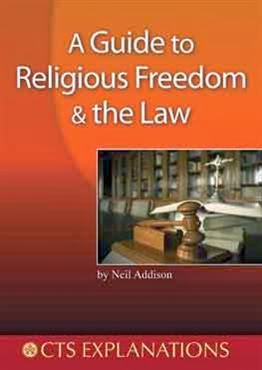
Guide to Religious Freedom and the Law

In January 2014 the Catholic Truth Society published a booklet “Guide to ReligiousFreedom and the Law” written by me. 

It is described as “an attempt to provide information on aspects of the law relating to Religious Freedom and Discrimination which are of specific interest to Catholic Institutions and individual Catholics in particular the Human Rights Act 1998 and the Equality Act 2010.”

The CTS booklet is not of course my first book on the subject however the CTS booklet is far more specific and targeted than most law books. “There are a large number of Books and official guidance covering Discrimination and Human Rights Law but the specific exemptions in the law which apply to religious organisations are often covered in a cursory way or relegated to footnotes. In this CTS book by contrast the exemptions and how they apply is the main area of interest”

By concentrating on what are the specific legal issues applying to the Catholic Church, Catholic Organisations and individual Catholics I hope that the booklet will be easier for non lawyers to understand.  In any law book there is a balance to be struck, cover everything and the book becomes unreadable except to the professionals, do not cover everything and someone is bound to complain that you have ignored an issue that they consider important. I can only hope I have struck the right balance with this Guide.

One of the areas of Equality Law I am very conscious I did not cover is Disability Discrimination. This is not because the subject is unimportant but because of the need to keep the booklet focused. I have however provided weblinks to organisations representing Blind and Deaf Catholics who can provide help and guidance in this area

Though the booklet is aimed primarily at a Catholic Audience I hope that it will also be of assistance to members of other religions and Churches since many of the legal questions are common across religious boundaries. 

Though the booklet is designed to give legal advice it is not my intention to encourage litigation or 'I know my rights' confrontations. Recourse to the law and to litigation should be the very last resort of any individual. If at all possible disputes are best resolved through patient discussion away from the glare of publicity.

I take the opportunity provided by the Booklet to to explode one persistent legal myth. Despite frequent assertions to the contrary there is absolutely NO legal rule which prevents a Roman Catholic becoming Prime Minister or indeed any form of Government Minister. There are of course legal restrictions preventing the Monarch from being, or being married to, a Roman Catholic but there are no other restrictions preventing Catholics playing their full part in Society.  I refer those who are interested to my earlier posts on the subject A Catholic Monarch ? The Act of Settlement 1701 and Myths about Catholics and the Monarchy

The booklet deals with the legal situation in England, Wales and Scotland but not Northern Ireland which, for historical reasons, has its own legislation dealing with Religious Discrimination. It is available from CTS priced £2.50

Thursday, 12 December 2013

Scientology is a Religion - Hodkin v Registrar-General

The Supreme Court in Hodkin v Registrar-General of Births, Deaths and Marriages [2013] UKSC 77 has decided that Scientology is to be regarded as a Religion and that its Chapels can be registered under the Places of Worship Registration Act 1855.  The relevance of the 1855 Act is that premises registered under it can then be registered to perform Marriages under the Marriage Act 1949

The Claimants are Scientologists who wanted to be Married in the Scientology Chapel in London which was not however registered under either the 1855 or 1949 Acts.  This was because of the 1970 case of R v Registrar General, ex parte Segerdal [1970] 2 QB 697 where the Court of Appeal had held that Scientology was not a Religion and its Chapels were not places of Religious Worship.  In Segerdal Lord Denning had memorably said of the definition of Religion and the concept of Religious Worship

'place of meeting for religious worship' as used in the Act of 1855. It connotes to my mind a place of which the principal use is as a place where people come together as a congregation or assembly to do reverence to God. It need not be the God which the Christians worship. It may be another God, or an unknown God, but it must be reverence to a deity. There may be exceptions. For instance, Buddhist temples are properly described as places of meeting for religious worship. But, apart from exceptional cases of that kind, it seems to me the governing idea behind the words 'place of meeting for religious worship' is that it should be a place for the worship of God.

"Religious worship means reverence or veneration of God or of a Supreme Being. I do not find any such reverence or veneration in the creed of this church. … When I look through the ceremonies and the affidavits, I am left with the feeling that there is nothing in it of reverence for God or a deity, but simply instruction in a philosophy. There may be belief in a spirit of man, but there is no belief in a spirit of God."

whilst Buckley LJ had said
"Worship I take to be something which must have some at least of the following characteristics: submission to the object worshipped, veneration of that object, praise, thanksgiving, prayer or intercession."

English Courts and the Registrar General were therefore bound by this definition until the Hodkin case came before the Supreme Court since only the Supreme Court has the power to overule a decision of the Court of Appeal.  

In considering the 1970 Segerdal case and its relevance in the rather different cultural and legal environment of 2013 the Supreme Court noted that the rather narrow definitions used in Segerdal had been rejected by the High Court of Australia in Church of the New Faith v Commissioner of Pay-Roll Tax (Vic) [1983] HCA 40; (1983) 154 CLR 120 (27 October 1983) , by the US Courts in the case of Malnak v Yogi 592 F.2d 197 (1979) and, to a rather more limited extent by the European Court of Human Rights in Kimlya  v. Russia

Lord Toulson gave the Judgment of the Supreme Court and noted the problems with the Segerdal definition

 51: Unless there is some compelling contextual reason for holding otherwise, religion should not be confined to religions which recognise a supreme deity. First and foremost, to do so would be a form of religious discrimination unacceptable in today's society. It would exclude Buddhism, along with other faiths such as Jainism, Taoism, Theosophy and part of Hinduism. The evidence in the present case shows that, among others, Jains, Theosophists and Buddhists have registered places of worship in England. Lord Denning in Segerdal [1970] 2 QB 697, 707 acknowledged that Buddhist temples were "properly described as places of meeting for religious worship" but he referred to them as "exceptional cases" without offering any further explanation. The need to make an exception for Buddhism (which has also been applied to Jainism and Theosophy), and the absence of a satisfactory explanation for it, are powerful indications that there is something unsound in the supposed general rule.

52: Further, to confine religion to a religion which involves belief in a "supreme deity" leads into difficult theological territory. On the evidence of Mrs Wilks, Scientologists do believe in a supreme deity of a kind, but of an abstract and impersonal nature. Ideas about the nature of God are the stuff of theological debate.


 In Para 57 of the judgment Lord Toulson laid down what will undoubtedly now become the standard definition of religion in UK Law, despite his caveat at the end, 

57:  I would describe religion in summary as a spiritual or non-secular belief system, held by a group of adherents, which claims to explain mankind's place in the universe and relationship with the infinite, and to teach its adherents how they are to live their lives in conformity with the spiritual understanding associated with the belief system. By spiritual or non-secular I mean a belief system which goes beyond that which can be perceived by the senses or ascertained by the application of science. I prefer not to use the word "supernatural" to express this element, because it is a loaded word which can carry a variety of connotations. Such a belief system may or may not involve belief in a supreme being, but it does involve a belief that there is more to be understood about mankind's nature and relationship to the universe than can be gained from the senses or from science. I emphasise that this is intended to be a description and not a definitive formula.

 The decision of the Supreme Court to recognise Scientology as a Religion for the purposes of the 1855 Act will undoubtedly lead to Scientology being recognised as a Religion for the purposes of Charity Law and also clearly for Discrimination Claims under the Equality Act 2010 

What is also interesting in both this case and last weeks case of Mba v Merton Council the Courts have accepted that they should not allow themselves to be drawn into detailed theological arguments.  Personally I welcome the decision, even though the Church of Scientology is a controversial organisation I would be concerned at any attempt by legislature or Courts to determine what are "acceptable"  and "not acceptable" religions

Thursday, 5 December 2013

Mba v Merton Council - Christians and Working on Sunday - Part 2

The Court of Appeal has issued its judgment in MBA v London Borough of Merton [2013] EWCA Civ 1562 which is an Appeal from the Employment Appeals Tribunal judgment MBA v London Borough of Merton  [2012] UKEAT 0332_12_1312.

I blogged about the case on 11 January 2013 and whilst I was not surprised that Mrs Mba lost her case on the facts I was extremely concerned at the legal reasoning of the EAT and for that reason I am extremely relieved by the Court of Appeal decision, Mrs Mba still lost her case on the facts but an an entirely different legal basis.

Ms Mba was a care worker at a registered children’s home which, not surprisingly,  was open 7 days a week, 24 hours a day and requires full staffing at all times.  Mrs Mba however is a Christian who believes that it is wrong to work on Sunday.  When she was eventually rostered to work on a Sunday she did not attend work on the Sundays she was rostered and disciplinary action followed. Eventually she resigned alleging "indirect" religious discrimination.

On the facts of her employment I have to say that I cannot see that there could be any question of Mrs Mba ever winning her case.  The Children in the home had to be fed and cared for on a Sunday just as much as on any other day and personally I would see that as performing a Christian act however that is of course merely a personal view


 In the case the Employment Tribunal and the EAT had considered a witness statement that had been put in on behalf of Ms Mba by Bishop Nazir Ali which said.

“Some Christians will not work on the Sabbath (except for mercies), others may work only in an emergency.”

In deciding allegations of Indirect Discrimination, as occurred in this case, a Tribunal was supposed to be satisfied that a "group" of people are affected by the alleged Discriminatory practice and the evidence from Bishop Nazir Ali did this by stating that "some Christians will not work on the Sabbath".  The EAT however turned this around by deciding that because  "some Christians will work on the Sabbath" that meant that because only a minority of Christians would refuse to work therefore it was permissible to require Christians to work because only a minority of them would be affected.


I stated at the time that the EAT had  "seriously misunderstood discrimination law." and I am glad to see that the Court of Appeal agreed. 

In the decision Lord Justice Maurice Kay held that what mattered was whether Mrs Mba had a sincere belief which was held by some Christians.  He went back and reemphasised the fundamental test laid down by Lord Nichols at para 22 of Williamson v. Secretary of State for Education [2005] UKHL 15 where he said

 "When the genuineness of a claimant's professed belief is an issue in the proceedings the court will inquire into and decide this issue as a question of fact. This is a limited inquiry. The court is concerned to ensure an assertion of religious belief is made in good faith: 'neither fictitious, nor capricious, and that it is not an artifice', to adopt the felicitous phrase of the Jacobucci J in the decision of the Supreme Court of Canada in Syndicat Northcrest v Anselem (2004) 241 DLR (4th) 1, 27, para 52. But, emphatically, it is not for the court to embark on an inquiry into the asserted belief and judge its 'validity' by some objective standard such as the source material upon which the claimant founds his belief on the orthodox teaching of the religion in question or the extent to which the claimant's belief conforms to or differs from the views of others professing the same religion. Freedom of religion protects the subjective belief of an individual. As Jacobucci J also noted, at p.28, para 54, religious belief is intensely personal and can easily vary from one individual to another. Each individual is at liberty to hold his own religious beliefs, however irrational or inconsistent they may seem to some, however surprising."

 Lord Justice Maurice Kay emphasised that there may be legitimate differences of belief within religions at para 14 when he said.
This sensitivity to the diversity of beliefs between and within religions is something which flows from the respect that is accorded to the range of sincerely held religious beliefs.

 Paradoxically the fact that her belief was a minority one made it easier to accommodate her.

Lord Justices Elias and Vos went further and applied Article 9 of the European Convention on Human Rights to the issue of Religious Discrimination.  They decided that it was wrong to even look at whether the Appellants beliefs were shared what mattered was whether they were sincere. 

Para 37 Elias:  in my view, it is the Article 9 dimension of this case which made it inappropriate for the Employment Tribunal, when assessing justification, to weigh in the employer's favour the fact that the appellant's religious belief was not a core belief of her religion so that any group impact was limited.

para 41 Vos:  The question of whether Mrs Mba's belief was widely held might, in theory and absent Article 9, be relevant to the proportionality question for the reasons I have given. But there is no reason why regulation 3(1)(b)(iii) cannot be equally well read to exclude such a consideration on the ground that Article 9 does not require any test of group disadvantage, and concentrates only on the religious freedom of the individual concerned.
 
The decision, though it does not help Mrs Mba will certainly make it easier to bring and to win claims of Religious Discrimination.  The disgraceful decision by the Court of Appeal in Ladele v London Borough of Islington [2009] EWCA Civ 1357 that Mrs Ladele's belief in the sanctity of marriage was not a 'core' part of her religion has now been finally put to rest.  This should avoid Courts and Tribunals in the future being driven into arguments about theology which the House of Lords in Williamson had accepted are outside the competence of secular courts